Gimme a Trance
Audio, protests, the divine, bodies, and how I'm tending my spirit.

Two friends asked me in the last weeks about my spiritual practices in this time—three months and 22,835 deaths into a genocide funded by our tax dollars. When I first drafted this letter a week-ish ago, that number was 20,000. I hate googling “Gaza Death Toll,” as I’ve done while writing press releases, seeing the number ever-higher than the last release. Where the hell are you God in this carnage?
In a poem, adrienne maree brown described protesters “praying with their bodies.” I have found the divine these last weeks alongside children spelling “No Aid for Genocide” in candles, or dancing on a bridge blocked arm in arm, or standing on overpass above bodies blocking traffic. I hailed the journalists and wrangled the TV crews. This organizing is new but it’s pulled me in tight. The only God I understand is among these resisters. Please, God, bring me deeper.
At my most atheist, I think God is the brain, a nervous system mirroring yours and yours and yours—just as mystical as any supernatural being. These bodyminds require worship too. Poet Hala Alyan wrote recently, “All relentless entities depend enormously on a few things: your fatigue. Your hopelessness. Your turning away.” We can’t afford that blasphemy.
I am learning, rapidly, to notice the spirit flickering, when those “relentless entities” might win. Their threatened victories are pain, depression, manic overwork, stifled grief, numbed rage. Resourcing isn’t optional and I gotta skill up fast.
These things have helped. You’ve gotten lots of reading lately, so here’s some audio. They ask me to set aside rugged intellect (which is usually my shit). Gimme a trance instead. Pressing play is good for that. More books and essays soon.
I love you,
Jesse
“On the Courage of Listening to our Bodies” with Fariha Róisín on For the Wild
Ayana Young’s podcast For the Wild: An Anthology of the Anthropocene is an incredible body of work. Fariha Róisín, who I have quoted in this newsletter often, is a voice you must hear during this genocide (Follow her Insta and her newsletter How To Cure A Ghost). This episode was (I think) recorded before October 7th, but I’ve been returning consistently to her reminders to treat the body as a portal. The more I come to terms with my chronic pain, the less this feels like a metaphor. She says:
I think our bodies are revolting; they are in revolt…I think that what our bodies are telling us and what our bodies are showing us through illness, primarily, and through everything from grief to depression are lighthouses back to ourselves. They're lighthouses back to our internal feelings and the way that we are inside of not just our brain, but our emotions and our body. And our body is such a vessel and a vehicle for us to heal, and better understand one another. I think there's a reason that we are embodied in this lifetime and this form during during the Anthropocene—during such tectonic times and such awe-inspiring times, because so much is happening at once.
For Sacred Consideration from Jo Kent Katz
A friend sent this recording my way with no explanation. Bless her. It’s woo-woo, but I won’t lie, I like that shit. I listened to the first lesson, wet from a shower, on the bed, late at night, exhausted enough to tumble into a trance. I softened, hearing “You are in extraordinary care.”
Tonight, I said out loud, alone to myself, as I sometimes do when I am ignoring or pushing through, “I am in a lot of physical pain.” I often have to say this to remember. It’s grief. And rage. The body is “in revolt.” Then I laid in bed and paid $4 for the Patreon subscription to access the rest of these teachings. I listened and wept after days of numbing. My ribcage shook beyond my conscious control, a sensation of release I recently learned (past infusions, in a clinic, of a club drug sure helped).
“Pace yourself,” she says, “please. Hydrate. Feed your body. Rest your body, when you can. For this time of transformation is both magnificent and excruciating. And each of you are a beautiful, undeniable, necessary, exquisite and beloved participant.”
“Centering at the End of the World,” How to Survive the End of the World, adrienne maree brown.
Lately, almost daily, I’ve been doing adrienne maree brown’s rendition of Generative Somatics’ centering practice. This practice has been showing up more frequently in my life—on my bodyworker’s table, on the lips of friends, and, most recently, in several anti-zionist Jewish spaces. The practice encourages me to center in four directions, each with a corresponding metaphor: length (dignity), width (connection and boundaries), depth (time, ancestry, presence, future), and purpose (commitment, longing, what am I on this planet to do?). This was recorded in late 2020, in the depths of another moment of apocalypse (just three years ago, three long years ago).
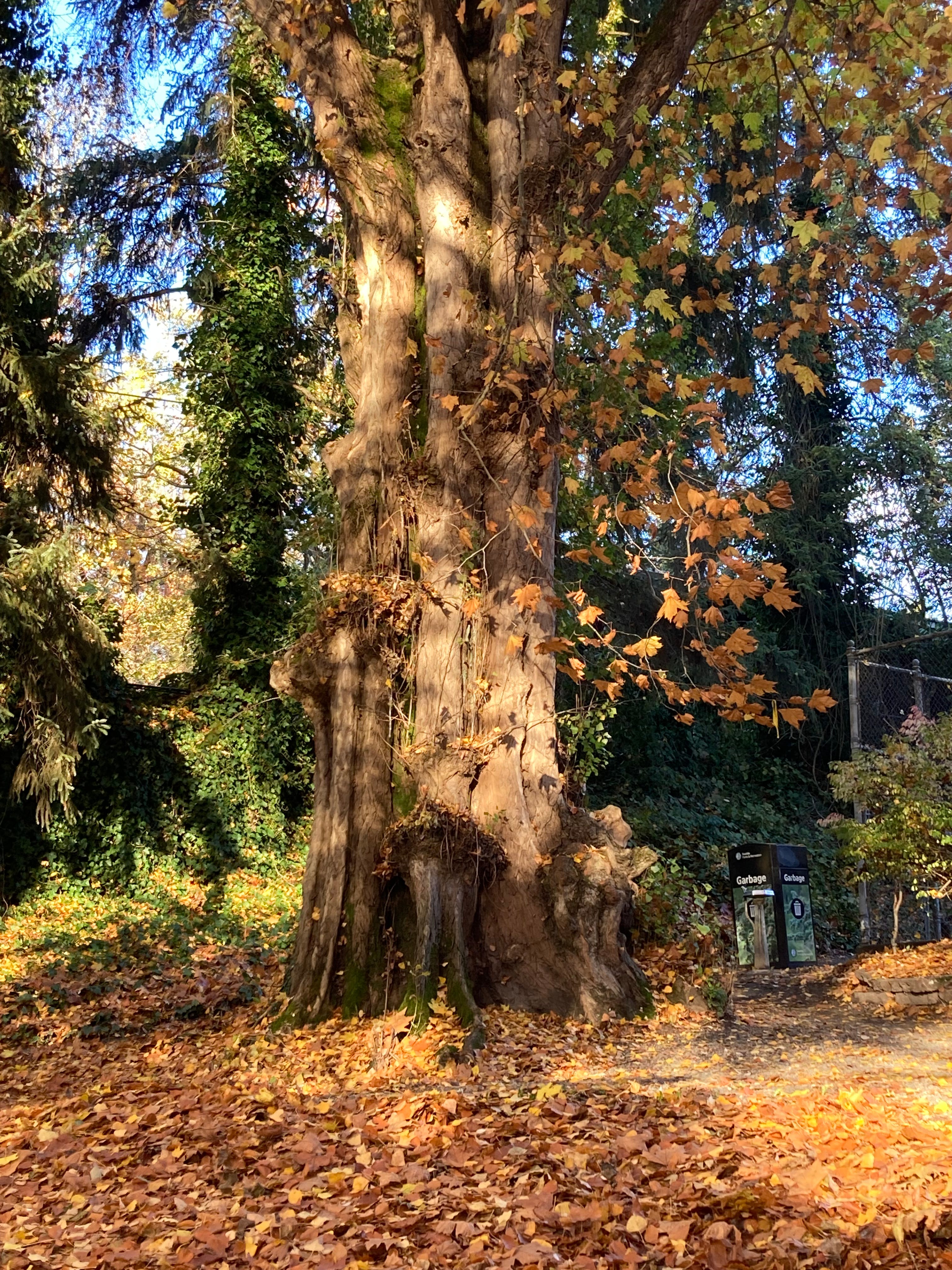
I’ve been practicing this tucked in the nook of a giant, really smart tree in Volunteer Park. Her 400-odd years of roots, rings, and witnessing offer me wisdom (mostly) without language—a blessing for a wordy little thing like myself. She reminds me that there is a pathway to a free Palestine in my lifetime; to a new world that offers safety, dignity, and care for us all; and to the belonging I most crave. This path will require my participation (and yours), an unforeseen collective imagination, and—among so many other things—so much good art.
Here’s a glamour shot from the sunny fall.